I will not be a Buddhist because it is easy,
I will not be a Buddhist because it is convenient,
I will not be a Buddhist because it is simple.
I will be a Buddhist because it is meaningful and worthwhile! ^_^
Bite-sized Dharma on the go!
I will not be a Buddhist because it is easy,
I will not be a Buddhist because it is convenient,
I will not be a Buddhist because it is simple.
I will be a Buddhist because it is meaningful and worthwhile! ^_^
This is a fictitious story about a boy who fell ill. To protect the identity of this non-existent fictitious boy, let’s call him Ah Boy.
So this Ah Boy fell ill. Did I tell you he caught a flu? I didn’t? It’s flu alright, but no, not the swiney type, the usual type. He is not very into porkchop and all you see. Anyway, he went to the doctor and after consultation, he collected the medicine and went back home. $20+ dollars and an MC* later, he is back home. He stayed away from school for the few days covered by the MC, but somehow was not getting better.
After a few days, he went back to the doctor and demanded to know why he was not recovering. The doctor asked him about the medicine and he said “I went back and did it every day.”
The doctor became curious, “You went back and did it every day? Did what?”
“I repeated the steps.”
“Repeated the steps?”
“Yes, I repeated the steps daily. I recited ‘Take this 2 pills, three times a day after meal’ everyday. Matter of fact, I did that every few hours.”
If you are like the doctor, you would be flabbergasted. In fact, most people would find this ridiculous and shrug it off as a fictional story. But on some occasions, I find Buddhists doing just that. They would religiously recite the suttas (or sutras for that matter) without applying what the sutras expound. Good Buddhist (*wink*) would know that the recitation of the sutras (as in a puja) forms a devotional practice and when done properly, can be a good development of mindfulness and attentiveness (or even concentration). They (the latter) would also know to reflect on the meaning of the teachings expounded in the sutra and rightly apply them in their daily lives, benefiting from the practice.
Take for example, Mangala Sutta, a sutta frequently recited in Theravadin temples. It is a sutta about a deva (god, or heavenly being) who visits the Buddha and ask him a very simple questions that many seeks to know: “What is the highest blessing?”. Perhaps a more conventional phrasing of this question would be, “How can one be blessed? How can one be blessed in the highest way?” Make sense now? Well, hence the name of the sutta, Mangala sutta, Blessings. Some translate it as “Protection” … but let’s not split hairs for now. The point is, the Buddha then replies to the deva in verse, declaring the various ways that one may be blessed (or protected).
Rightly speaking, besides chanting it in a puja, one should frequently reflect over the meaning of the verses and live one’s life accordingly if one wishes to truly receive blessings. Then would one receive and apply the Buddha’s guidance and blessings.
So this Vesak, go visit the temple, bathe the baby prince Siddhartha, take your refuges and renew your precepts, do your offerings, listen to the Dharma talks, and reflect how you fared this past year. Are you happier than in the past? Are you happier because you have more things, or because you change your mindset? Have you progressed in your practice? Are you more prone to anger or are you calmer? Still jealous over the raise and fat bonus someone else get? Have you talked to your father and mother recently? How about your siblings? Have you cared for someone else besides yourself? Do you care more?
You owe it to yourself to reflect over your life. And do something about it. Happy Vesak! 🙂
References:
Khuddaka Nikaya: Sutta nipata 2.4 Mangala Sutta
* MC – Medical Certificate. In Singapore, the acronym MC has taken on a life of its own, to be used as a verb. eg, he play MC. or as a noun, eg. he went on MC. The former usage “he play MC” is usually used to denote that such as person is faking illness and got an MC to justify his absence. The latter is usually less insinuating, but has similar connotations.
Of late, I noticed numerous blogs discussing atheism and christianity. Here are some thoughts about it.
Believing that some divine being will come and save us all from evil is shirking our human moral responsibility to each other. We keep talking about human rights. Maybe we should start talking about human responsibilities. We should be responsible for our actions towards each other, regardless of whether there is a god or not. Last I check, no being came in to stop hitler, or the japanese, or the a-bomb, or any of the despot regime on genocidal paths. It is up to us to do the right thing and the last thing to do, is do the right thing and then attribute it to some god that may or may not exist.
Why should we blame our own flaws on some external evil and call it satan? Convenient? Yes! Practical? No! We should stop and be answerable to ourselves and stop being whiny kids pointing fingers at some invisible fiend.
I wonder with amazement every time a talented person comes on stage to receive accolade for some good work he has done would begin or end with “Thank god … ” or “it would be impossible without god willing … “. Why do we think so lowly of ourselves? That human beings are incapable of doing any good except if god is around? Is this a twisted evolution of humility? Or is this a nascent form of humility that has somehow got stuck in social evolution and remain as part of human traits?
We should be confident of the good that we can do with our human effort. That it is possible to bring about happiness and peace without the presence of some divinity or invisible friend or fiend. Maybe if we can be honest with ourselves in this way, then we can be at peace with ourselves. And with others. With or without god. Or heaven.
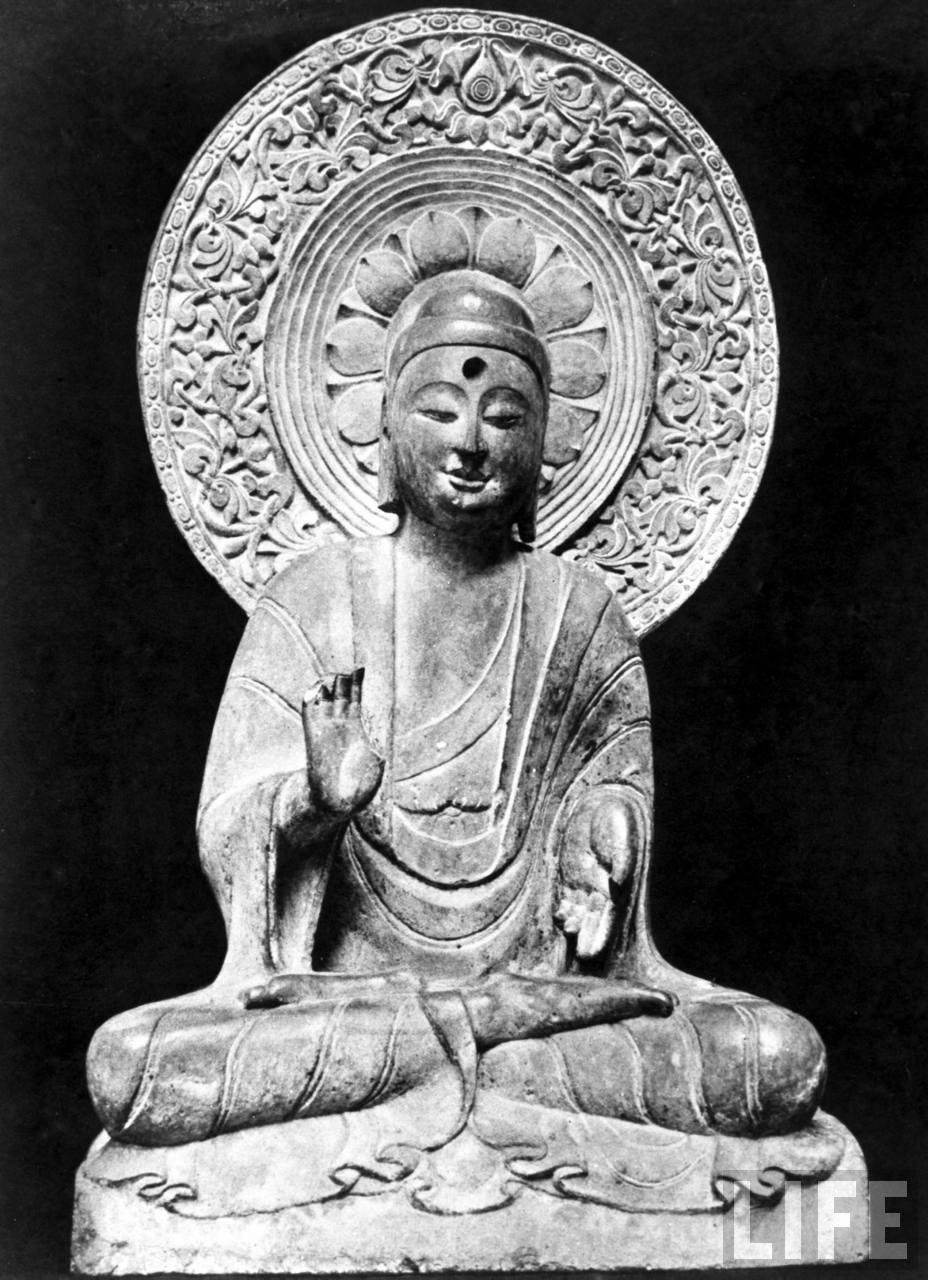
Life sized statue of the Buddha from the Tang Dynasty period (618-906 AD)
應以何身得度者,即現何身而為說法 does not translate to “Teach the Dharma in the local language”. The Chinese text would translate loosely to “Depending on the need of the audience, (one) shall manifest in whatever form/appearance to teach the (Buddha) Dharma”. This is the crux of the teachings in “妙法蓮花經 觀世音菩薩 普門品” Saddharma-puṇḍarīka sūtra, chapter on Samantamukhaparivarto nāmāvalokiteṡvara-vikurvaṇa-nirdeṡa.
Confused yet? Ya, thought so. For those of us who are do not read sanskrit or Chinese, the above lines might as well have been written in greek or an alien language, which brings me to the earlier statement, that one shall manifest in whatever form/appearance to teach the Dharma, depending on the need of the audience. That should include adopting whatever language is appropriate for conveying the message. The language is but a medium, a tool while style and prose just an expression of that medium. The intended message is what is important. And because of that, language, style and prose should be chosen to encourage communication. The communication of the message, of the idea, rises above previous trio in importance.
Preface
In this HowTo series, we explore the Pureland Practice. The contents herein is set at level 100 ~ 200, meaning it’s targeted at introductory to beginners’ level.
100 – Introductory
200 – Beginner
300 – Intermediate
400 – Advanced
This article was first drafted in 2007 and intended for publication on this blog. It was later revised and published in the December issue of Vaidurya 2008. It is now published here for public reading.
Introduction
Pureland Buddhism is ubiquitous in Chinese Mahayana Buddhism. Throughout most, if not all, Chinese temples and monasteries in Singapore, Malaysia, Taiwan, Hongkong, China, worldwide, pureland practise is more well known than perhaps meditation practises like anapanasati (breathing meditation) and satipatthana (Four foundations of mindfulness). In certain cases, a Buddhist may even know only to chant “Amituofo” and nothing about the Four Noble Truths and Eightfold path. Sometimes this is due to the literacy level in the audience and other times, due to the level of the sangha community. Try explaining the Four Noble Truth and Eightfold path to an 80 year old granny who can barely understand you or try getting youths to understand the dharma talks of elderly monks who only speak some native chinese dialects or who can only manage a strongly accented chinese dialogue. In such cases, it may prove trying for both parties.
Due to the increased literacy level of Singaporeans, such scenarios are fortunately, greatly reduced. The Sangha today are mostly conversant in English and Chinese and in certain cases even in a third or fourth foreign language. With language as a tool rather than a barrier, Buddhists can learn more about the Buddha’s teachings, as did the monks and lay folks did 2550+ years ago. This then bring us to the topic at hand, how do we learn and practise Pureland in today’s context? Is pureland practices only meant for the elderlies or can the younger generation embrace it just as well? Should we restrict ourselves to mere recitation of “amituofo” or should we do more? Is there such a need? If so, what else are we to do? These are some questions we will look at and offer some thoughts about it, hopefully intriguing you enough to think about it as well.
What is the Pureland school?
The Pureland school refers to a branch of Mahayana Buddhism that centres around a basic belief that while unenlightened sentient
beings reside in samsara (cycle of birth and death), Buddhas reside in worlds called Purelands, an existence that is somewhat apart from the six realms (also referred to as the five realms in Pali Canon). These worlds are manifested through the Buddhas’ boundless merits and individual vows, and hence each world differ slightly in style, structure and entry pre-requisites. Our world in contrast, are manifested through our individual and combined karma, which as it is, is filled with a mixture of temporary happiness and suffering, due to the varied defiled mental states in which we act. The Purelands are free of suffering in nature and conditions for defilements to arise, hence the namesake. Compare this to our world where conditions for defilements abound, and it almost seem like the natural decision to want to aspire for entry to Purelands.
Each pureland differ according to the vows and aspirations of the residing Buddha of that world. Some may make it a pre-requisite for only stream-enterers (Sotapatti) and above to gain ‘entry’ while others may ‘only’ require Bodhicitta as a pre-requisite. One particular pureland that is extremely popular amongst Chinese Mahayana Buddhist is the Sukhavati Pureland (极乐世界) where Amitabha Buddha is the presiding Buddha. So for most Chinese Mahayana Buddhist, pureland practice is almost always equivalent to recitation of “amituofo” (Chinese phonetic-translation of ‘Amitabha Buddha’). For the most of this article, we will focus on the Sukhavati Pureland (极乐世界)
Entry Prerequisite
There are three prerequisites to entry to Sukhavati Pureland: 1) Faith-confidence 2) Vows-Aspiration and 3) Practise
1. Faith-Confidence
Most interpret this to have the faith that Amitabha Buddha would come to ‘pick us up’ when our time is up. Faith is that and more. Faith in Buddhism is more of the confidence in the Buddha, his Teachings and the Sangha community of monks and nuns. This includes the confidence that the Buddha’s teachings on the Four Noble Truth and Eight-fold path is true. To have this confidence requires us to learn about it and then reflect and compare with our own experiences to verify our ourselves its validity. It is through this self-verification that we gain confidence.
Having faith here also includes understanding some core teachings central to pureland teachings. Amongst them, one should learn and realise that samsara, this cycle of birth and death, is suffering (The First Noble Truth of Suffering) and is full of conditions conducive for our defilements to arise. In addition, one should know and have faith that the purelands are conducive for practise in many ways. Here I would summarise into three parts: 1) Internally and 2) Externally and 3) Dharma Teachers. Internally, there are no physical sufferings of any sort and enjoy much bliss. Some think that, one may then enjoy all sorts of sensual pleasure and vices there. That is incorrect. In Buddhism, ultimate bliss is usually expressed as the absence of suffering. Further, it is said that any joy one may experience in pureland will not lead to an arousal of defilements. Hence, no sensual pleasures or vices there. Without sufferings and conditions for defilements, our mind can be calmer and more conducive for learning and practising the Dharma.
Externally, all the things we need is there for our perusal; we don’t need to study worldly knowledge to make a living, and we don’t need to spend a third or more of our life at work! In this way, we can devote so much more time to learning and practising. In addition, even the environment, with its birds and heavenly-like music, would speak of the various Dharmas and arouse thoughts relating to the Buddha, Dharma and Sangha. In this way, amongst others, the western pureland is known as extreme bliss (极乐).
Perhaps the best part about the pureland is that the teachers there are amongst the best! Chief of them all is Amitabha Buddha flanked by none other than
Avalokiteshvara Bodhisattva 大悲觀世音菩薩 and Mahasthama Bodhisattva 大勢至菩薩. Having enlightened teachers is definitely a plus point in pureland as they have Perfect Wisdom and Skilful means to teach us according to our mental capacity and inclination.
But having confidence is not limited to thinking that pureland is a wonderful place to be in for learning and practising the Dharma. Having confidence is actually an active process of learning the Dharma to affirm one’s conviction. So as part of Faith-confidence, one should start learning the Dharma and it should should at the very least result in taking refuge in the Triple Gem, the Buddha, Dharma and the Sangha.
2. Vows-Aspiration
With renunciation, we seek to be liberated from samsara and not to continue with self-centred lifes that is concerned with only pleasure and enjoyment. Instead we earnestly aspire towards rebirth in the purelands. Further, we should also see that others around us, including all sentient beings, are still mired with delusion, suffering in samsara. Seeing thus, we should develop bodhicitta, making strong vows to attain Enlightenment in order to show the path to others so that they may also, rightly practising the Noble Eightfold path, attain to Nirvana.
Hence, a brief understanding of vows and aspiration in pureland should be at least three-fold: 1) Renunciation towards samsara, 2) seeking rebirth in the purelands and 3) Developing Bodhicitta to learn the complete Dharma here and now, and later in the purelands in order to benefit other sentient beings.
3. Practise
All talk and no walk, is day-dreaming. A ship with proper maps and bearings but no movement gets nowhere while a ship on high speed in the wrong direction is either going to go aground or run out of fuel. Grounded in the proper teachings, and setting one’s goal firmly, one should move forth and start practising.
The practice in the Pureland school follows the standard Three-fold Practice of Precept, Concentration and Wisdom. At a minimal, it takes the form of the recitation of the Buddha’s name, at the higher level it involves learning the Buddha’s Teachings and meditating to realise the True Nature of all Phenomena.
Practise: Precepts
As a pureland practioner, one should have taken refuge in the Triple Gem starting in the first stage of Faith-Confidence. From there, one should further observe at the very least the Five Precepts and where possible, the Eight-Precepts on a regular basis.
Having purity in one’s precepts forms a strong foundation for further learning and practise of Concentration and Wisdom.
At the core of pureland practices is the Recitation of the Buddha’s name. Before one begins reciting the Buddha’s name, one should aspire to purify one’s bodily, verbal and mental karma and be mindful while doing so. Firstly, when one is reciting the Buddha’s name, one should not be doing any bodily actions that is unwholesome or against the precepts. Further, since one is either reciting verbally or mental, one’s verbal karma should be purified and not engaged in falsehood, harsh speech,
idle talk or divisive speech. Lastly, one should be mindful when one’s mind has strayed or wandered away. When it has wandered away, one should be aware of it quickly and bring the mind back to the recitation at hand. In this way, the three-fold karma is purified.
Secondly, with the mental training through recitation of Buddha’s name, one should be mindful when one incline towards unwholesome body, speech and mind. Knowing so, one should steer one’s mind away by reciting the Buddha’s name. In this two ways, one’s precept may be upheld.
Practise: Concentration & Wisdom
In addition, this ‘recitation’ or recollection (念) can be practised at different levels that lead to further development of Concentration and Wisdom. Note that the following practices inevitably
reinforces if not support the practise of the precepts, but are not the highlight of this introduction here.
Practise: C&W: Buddha’s name recitation
As mentioned earlier, it is the verbal or internal recitation of the Buddha’s name. Done to fruition, it can lead to calming of the mind. Depending on individual, one may find it easy to recite a 3~4 syllabus name or a 84-name mantra or even a mantra over thousands of characters, so name recitation may appeal to some but not others.
One can recite either “南無阿彌陀佛” (Namo Amituofo) or simply “阿彌陀佛” (amituofo). Some folks incorrectly think that “南無阿彌陀佛” means there is no Amitabha Buddha in the south! This is totally incorrect. In Buddhism, terms like names or terms that has meanings that are incompletely expressed in a foreign language are left ‘untranslated’. Their phonetic translations are used instead to avoid loosing or corrupting its meaning. In certain cases, it is left untranslated when the term is especially honoured or held in high esteem, as is the case for most names.
“南無” should be pronounced “namo” as in “Namo Tassa Bhagavato Arahato samma sambuddhasa” in the Pali and Sanskrit chanting. It means homage or salutation. So reciting “namo amituofo” is akin to paying homage to Amitabha Buddha while reciting “amituofo” is reciting of Amitabha Buddha’s name.
Practise: C&W: Buddha’s Image recollection
Another method is to recollect the Buddha’s image. This involves the visualisation of the Buddha’s image as a form of development of concentration. At one level, it is just the visual form, but at a deeper level, it is to see the “Buddha-ness” or Buddha-Nature in all sentient beings. This aids in the development of qualities such as loving-kindness, compassion and equanimity towards all sentient beings.
Practise: C&W: Recollection of the Buddha’s qualities
At another level, it is the recollection of the Buddha’s qualities. The Buddha, a perfectly enlightened One, has amassed innumerable merits and wisdom, and so in many ways is worthy for us to aspire towards. One practice starts with the earlier visualisation of the Buddha’s image. This visualisation lead to a basis for concentration (Sramatha). It can then be the basis for the corresponding qualities of the Buddha for each of these marks. This then becomes the recollection of the Buddha in terms of his qualities.
Another way to recollect the Buddha’s qualities is to start with learning and reciting the Buddha’s epithets such as 1) 如來 Tathagata 、2) 應供 Arahant 、3) 正遍知 Samyak-sam buddha、4) 明行足Vijja carana-sampanno、5) 善逝Sugato、6) 世間解 Lokavidu、 7) 無上士 Anuttara、8) 調御丈夫 Purisa dhamma-sarathi、9) 天人師 Sattha Deva-manussanam、10) 佛 Buddha、11) 世尊 Bhagavat.
Recollecting in this way, one abides by the qualities of the Buddha and becomes focus.
Practise: C&W: Ultimate Reality (Dharma) Contemplation
This contemplation refers to what is commonly known as vipassana (觀) or insight wisdom and in Buddhism, it refers to seeing how things really are. Some commonly known contemplation are recollection of the Emptiness of All phenomena (Madhyamika school), or that All phenomena is Consciousness-Only or that All phenomena is Impermanent, subject to Suffering and hence not fit to be considered as self. Reflecting in this way, one develops wisdom and ultimately sees the way they really are, removing ignorance and becomes Enlightened.
nAs the Buddha said in the Diamon sutra and the nikayas-agamas, “He who see the Dharma, sees the Tathagata. He who sees the Tathagata, sees the Dharma.” Hence the Contemplation and Seeing of Ultimate Reality, is synonymous with Contemplation and Seeing of the Tathagatha, the Buddha.
Next Step?
In this brief introduction to the Pureland School and its practices, we find that it is very rich in the learning of the Dharma and steep in the practice of Precepts, Concentration and Wisdom. Far from the stereotype image of mere recitation of Buddha’s name, it is a practise that is still very relevant today and can be applied at various stages by different people with different inclinations.
In future, we hope to explore the existence of pureland here on Earth and perhaps even take a look at two other controversial views: 1) Does pureland exist discretely apart from this world we know and 2) Pureland in Theravada Buddhism. For now, let’s start our practise and develop our pureland now.
EDIT:
Thanks to a tip-off, I’ve updated this post and fixed the truncated text. 
20110306 – 念佛功德 -> 功德念佛
https://confusion.tweakblogs.net/blog/1418/why-functional-programming-doesnt-catch-on.html
The above is an interesting article about functional programming and why it fail to catch on.
Every introduction to a programming language shows you the recursive method to calculate Fibonacci numbers. It’s abstract, many people do not relate to it very well, but it’s only a single example. However, the documentation for FP languages seem to consist solely of these kinds of highly mathematically inspired examples. No ‘Address’ class to be found there. Hasn’t anyone written a functional equivalent of the Pet Store application to demonstrate the power of FP for the regular work that most of us do?
This is sometimes the challenge I hear from people, that they find it too theoretical to apply certain religious concepts (be it Buddhism, Christianity, Hinduism, Islam or the religion you dig!) in their every day life. While some faith’s tenets and ideals are meant to be other-worldly, Buddhist teachings are meant for daily applications.
When we attend Dharma classes, we need to relate it to our daily experiences
and reflect upon how our life can be further improved. Is there anything we could have done or said differently? What can we do in future to be more considerate towards others? Was there relevance at all?
People that want to improve the world often overlook one fundamental problem: you cannot improve the world just by being right. You need to convince others of that fact if you want to exert influence. If you cannot convince them, find out why you cannot convince them. I think there is a bright future ahead for functional programming, as soon as someone stands up to convince the masses.
We need to be convinced for ourselves that the teachings really do work out. We need to try it out and see for ourselves. The Dharma is meant to be explored and experienced, not merely for recitation.
So start now, see if you can pick something about your day that you can change about. And see if you can apply the Buddhist teachings, then share your findings here.
😀