Who Slammed the Door?

Sometimes when a door or window slams, do you find that someone, sometimes ourselves, would respond with a “Who was that who slammed the door (or window)?”. And if the response is “Oh, it was the wind”, then almost magically, the agitation or annoyance subsides or disappears! If it turned out to be someone responsible, then a further exchange may take place. The annoyance becomes directed to the person responsible.

We like to find people to blame (or praise), don’t you think? This tendency to do that is preceded by the habit to affix a persona behind any experience or phenomena worth noting. In a way, this habit is also driven by the need or habit to blame. So this two tendencies are mutually supportive of each other.

Sometimes when we find that there is no person behind, say the slamming door or window, we are not satisfied. We are very smart. We use our intelligent mind to further investigate. Then we ask “who left the door open without securing it?”. And if that turned out to be indeterminate, we may continue pursuing until we find someone to blame. We are so full of energy when it comes to blaming people ya?

No, we are not like that? Yes, most people are not like that usually. But when we are in this energetic mode, then all hell breaks loose. We drill and question and conduct forensic analysis, just to get to the bottom of things! “Justice must be served” we might even exclaim!

What is the purpose of this “Justice” or “Rights and wrongs” if all it gets us into is this find-someone-to-blame-mode?

Coming back to the slamming door example, consider both possibilities, where someone slammed it or where the wind blew it shut, slamming it. In both cases, there was energy imparted to the door, causing it to move. Kinetic energy from the wind did the job in the latter, while kinetic energy from someone did it in the former. Both are energy. Does the door know the difference between the two sources of energy? No. Does the door slam differently in either cases? Nope, except when the energy imparted is of a different intensity.

Does the door slam with a “Ah Beng slammed the door” or “The wind slammed the door”? Nope. Yet, we impute additional meaning to the slamming door. I’m not denying that it is either the wind, Ah Beng or some sources that did it. I’m saying that

1) if the distinction of the sources is not meaningful in our and others’ happiness, then it is not meaningful to discern and cling strongly to such distinction.

2) the distinction is imputed, because the direct cause of the slamming is basically kinetic energy!* Not some person, or a being.

Discernment #1 is easier to accept and do, and it appeals to our pragmatic wish to be happy. It, however, only mitigates one’s problem. Discernment #2 is easy to understand, but harder to recognise internally or apply directly. If one is able to do so, then one weakens the root of the problem (Sakaya-ditthi) and in due time, cuts the very cause of suffering!

Many years back, I was at the Fa Yun monastery and was having lunch one day. One of the duty person dripped gravy onto the outer surface of my alms bowl. Being the unenlightened monk, a thought arose “Aiyaya! How careless!” After awhile I caught myself and reflected somewhat mindfully and all was well. Then another time, when I was on duty serving, I dripped some gravy on my own bowl! I simply wiped it off without a second thought or agitation. Then a thought arose “HA! …. ….”

I will leave you to ponder what followed that “HA!” … ^_^

Footnote:
* — If one observes rupa (form) mindfully with respect to the four elements, one sees
clearly that the slamming door, the wind or a “person” slamming it are basically a function of the wind element. In modern speak, kinetic energy.

Disagreeing or Not Understanding (Knowing)

There is a subtle difference between “not understanding” vs “disagreeing”.
Something that we commonly mix up and are blind-sighted to.

A: I disagree with this teaching.
B: So which part of this teaching do you not agree with?
A: I don’t know.
B: What do you mean?
A: I do not understand or know the teaching.
B: If you do not understand or know the teaching, how can you disagree with it?

Was having a chat with my mom, and had this epiphany!

This is a common problem we have. We tend to disagree with something that we do not know or understand. But to disagree with something, we should and need to first know what it is, before we can agree or disagree.

With
metta, ^_^

Happy National Day Singapore!

Flag of Singapore - Source @ wikipedia

Many years ago, a few hundred moons gone past, a boy was born to a family of the Forest (Lim) clan, on an Island they say once had a Lion roar
The boy grew up, loving the land that fed his family, he had this thing with flags crescent moon and five stars, decked in red and white halves
Perhaps he knew what these stood for, perhaps he is a patriot or perhaps he just love the chocolate candy that came in the flag stem core
So many years have passed, he’s gone through some studies, work and play, he decided that life is too precious to not try the Enlightened Buddhist Way
Following his preliminary monastic training, in a foreign land of freedom, he return to find his island country decked not with crescent moon and stars, but a ferris wheel and racing track

Give me
Merlion or the Angmo Raffles guy anytime instead, he shouted!
A statue of our founding statesmen like LKY would be something he would be proud to share with everyone compared to the ferris wheel, F1 tracks or GDP numbers!
Oh! He wonder out loud, is life really just about getting better grades and bigger houses? He thought if getting these were meant to lead to happiness, then why are people getting more stressed and unhappy driving around and not sleeping well in their upgraded houses?

Perhaps we need to come back to basics and remember what those crescent moon and stars mean to us as we wish our nation Happy Birthday

Rich or poor, this is our nation, with our friends and families, both born here and from shores afar
Remembering that red symbolises “universal brotherhood and equality of man”, and white, “pervading and everlasting purity and virtue” and that like the crescent moon, we are a “young nation on the ascendant”

While pursuing the 5Cs, we shall forget not that we will do so with our common ideals of democracy, peace, progress, justice and equality in our mind … and in our heart!

As I think of our Nation’s flag, and what it symbolises, I wonder why we forgot to add “Happiness” to the five?
Then I figured, it must be that Happiness is everyone’s goal, surely we don’t need to state something so universal right?
Right? … Let’s not forget that.

Oh Singapore, I love you so, but do you love me back or am I just another number?

Happy Birthday Singapore.

A Buddhist Monk ^_^ A Singapore Son

References:
http://vs.moe.edu.sg/national_symbol.htm
http://en.wikipedia.org/wiki/Flag_of_Singapore

From the MOE website:

Origin
The National Flag of Singapore is a symbol of statehood. It replaced the Union Jack which had flown over Singapore for 140 years (1819-1959). It was the committee headed by Dr Toh Chin Chye (the then Deputy Prime Minister) which first conceived of and created the flag. Together with the State Crest and the National Anthem, it was unveiled on 3 Dec 1959, at the installation of the new Head of State, the Yang di-Pertuan Negara, at the City Hall steps. Upon independence in 1965, it was adopted as the National Flag.

Meaning
Our National Flag consists of two equal horizontal sections, red above white. In the top left canton is a white crescent moon beside five white stars within a circle. The features of the flag were not arbitrarily chosen. Each feature has its own distinctive meaning and significance: red symbolises universal brotherhood and equality of man; white signifies pervading and everlasting purity and virtue; the crescent moon represents a young nation on the ascendant; and the five stars stand for the nation’s ideals of democracy, peace, progress, justice and equality.

Buddhist Interact Club @ Manjusri Secondary School

In May 2009, Venerable DingRong and me conducted a Students’ Heart Corner Programme (quite wordy in retrospect!) at Manjusri Secondary School.

The Students’ Heart Corner Programme (SHC) is a pilot programme aimed at giving the students at Manjusri Secondary School an additional avenue to interact with members of the Buddhist Sangha (monastic) community so that they may learn to cope with their emotions and be able to better handle stress and pressure in school. Structure and Duration

The pilot programme ran successfully every Friday for a group of 10 to 15 students, for the month of May, 2009. The programme included activities such as: Simple Awareness Meditation • Group Dialogue • Sharings • Hymns • Each session was conducted by us venerables and was assisted by Mrs Cheng and Mr Ng. The sessions was conducted at the Dharma / Multi-purpose Hall and lasted over 1.5 hours each.

Photo collage from the second session

Photo collage from the second session

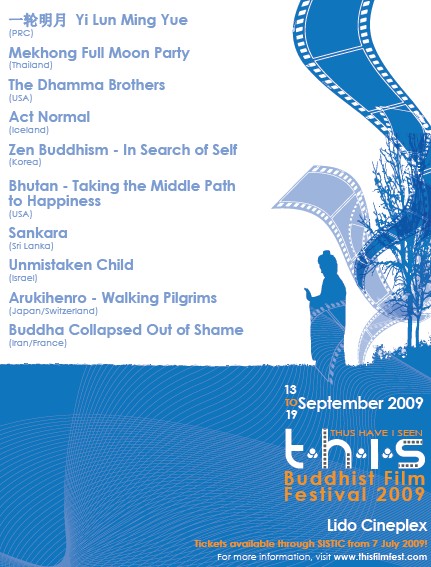
Thus Have I Seen (T.H.I.S.) Buddhist Film Festival 2009

Dharma In Action is pleased to present Thus Have I Seen (T.H.I.S.) Buddhist Film Festival 2009. 10 films showcasing Buddhist values and cultures from all over the world will be screened from 13 to 19 September 2009 at Lido Cineplex.
Visit www.thisfilmfest.com for more information and visit www.sistic.com to purchase your tickets now!